What is social value?
Understanding the Real Meaning Behind Wellbeing and Impact
What is social value, really?
It’s a term we hear everywhere – in bids, boardrooms, and government strategy – but it’s often misunderstood. In this guide, we’ll cover the term “social value” in the context of wellbeing, economics and community impact.
Whether you’re a social value lead, bid writer, or sustainability professional, this guide will help you build confidence in defining and communicating what social value means in your own context.
 Catherine Manning
Understanding the Real Meaning Behind Wellbeing and Impact
What is social value, really?
It’s a term we hear everywhere – in bids, boardrooms, and government strategy – but it’s often misunderstood. In this guide, we’ll cover the term “social value” in the context of wellbeing, economics and community impact.
Whether you’re a social value lead, bid writer, or sustainability professional, this guide will help you build confidence in defining and communicating what social value means in your own context.
If you find this useful, or would like help measuring, embedding, capturing and reporting on social value across your organisation, get in touch!
Social Value definition
Social value is a concept that’s increasingly central to how we think about the wider impact of organisations. But what exactly does it mean?
There’s no single, universally agreed definition of social value. Different sectors and organisations interpret it differently. But at its core,
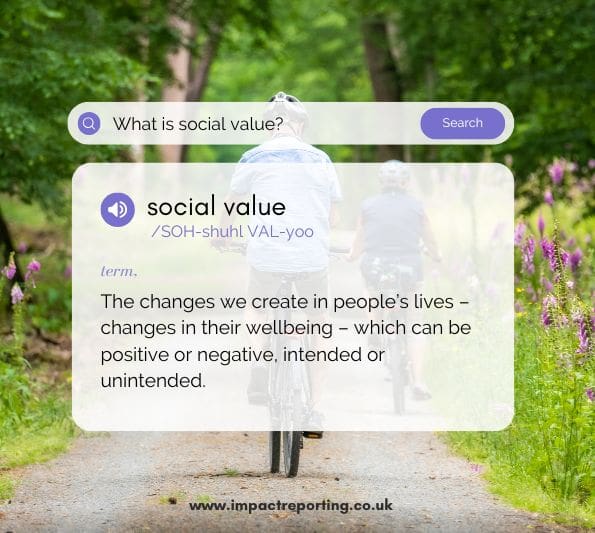
Social value is about the changes we create in people’s lives – changes in their wellbeing – which can be positive or negative, intended or unintended.
And crucially, valuing those changes from the perspective of the people experiencing them.
Understanding social, economic and environmental value
To understand social value more clearly, it’s useful to compare it with other types of value:
- Economic value: Changes in money, e.g. income, revenue, or costs. Typically captured through prices and financial transactions.
→ Financial accounting - Environmental value: Changes to natural resources, ecosystems, or carbon emissions.
→ Sustainability reporting - Social value: Changes in people’s wellbeing. These can result from things like access to jobs, education, health services, community connection, and more.
→ Social accounting
Why it matters
Social value matters because it helps us ask and answer the question:
Are we making as much positive impact as we can, as quickly as we can, with the resources we have available?
It moves beyond what’s easy to measure (like money or carbon) and focuses on what’s meaningful. And when done well, it ensures that decision-making reflects the real needs and experiences of people and communities.
A brief history
While the term “social value” rose to prominence in the early 2000s, the concept is much older:
- 1500s–1600s: Philanthropy and charitable giving formalised through legislation like the Poor Laws
- 1800s: Corporate social responsibility emerges during the industrial revolution (e.g. Cadbury, Peabody, Carnegie)
- 1987: The UN defines “sustainable development” including social, environmental and economic wellbeing
- 2012: The UK enacts the Public Services (Social Value) Act, requiring public sector buyers to consider wider value in procurement
Two common perspectives on social value
1. Community and contract-focused social value
Used in procurement, especially in the UK public sector. Defined by government as:
“Improvements to the social, economic and environmental well-being of the relevant area.”
This view sees social value as place-based, intentional outcomes, like:
- Creating local jobs
- Supporting small businesses
- Improving public health
- Reducing environmental harm
This version of social value leads to actionable contract specific commitments that have trackable delivery metrics often linked to public sector strategy and Government priorities.
2. Wellbeing-centred social value
Used in impact measurement and management, by Social Value Practitioners, and integrated into HM Treasury Greenbook practice.
Defined by Social Value International (SVI) as:
“The importance people place on different aspects of their wellbeing and the changes they experience.”
This approach emphasises:
- Capturing and valuing real-world outcomes for people
- Involving those affected in defining what value means
- Measuring changes in wellbeing in meaningful, non-market ways
(SVI sets the Principles of Social Value and is a global network for practitioners working in impact and social value.)
Other leading definitions of social value
BSI BS8950 (British Standards Institution)
“Social value is created through the generation of personal and collective wellbeing over the short and long term.”
This UK standard helps organisations embed social value in strategy and operations.
HM Treasury Green Book (2022)
“Social or public value includes all significant costs and benefits that affect the welfare and wellbeing of the population, not just market effects.”
This is the definition Impact Reporting uses for the MeasureUp framework. It aligns social value with welfare economics, taking into account all impacts on people, not just financial outcomes.
Public Services (Social Value) Act 2012
“Economic, social and environmental well-being”
This law put social value on the agenda in public procurement, though critics argue it lacks strong enforcement. Nevertheless, it helped spark broader awareness and adoption across government and supply chains.
Final thoughts
The main message to take away from this is that: there is not one size fits all definition on Social Value! The slide below has even more definitions. When reporting on social value to stakeholders it is important that you understand what they mean when they are talking about social value or define it:

Ultimately, understanding and maximising social value requires a holistic approach that considers both immediate benefits and long-term implications for society and the environment.
Key takeaways
- Social value is about the changes an activity creates for people’s lives – especially their wellbeing.
- There is no one-size-fits-all definition. It’s essential to clarify what social value means in your context.
- In public procurement, social value often focuses on local economic, community and environmental outcomes.
- In impact measurement, social value focuses on wellbeing and lived experience.
- The most credible approaches involve listening to stakeholders, defining value through their eyes, and measuring real change.
Practical example
A construction company delivering a school contract may generate social value by:
- Hiring local apprentices (economic and community wellbeing)
- Reducing air pollution during works (environmental wellbeing)
- Running after-school clubs or workshops for pupils (social wellbeing)
Each of these creates value — but only becomes social value when the change in wellbeing is understood, measured, and valued.
Resources for further reading
- Social Value International: What is Social Value?
- UKGBC Framework: 23 Definitions of Social Value
- Impact Reporting – Social Value Examples
- BSI BS8950 Overview
- HM Treasury Green Book 2022
What’s the Difference Between Social Value, ESG, CSR, and Social Impact?

In short:
- CSR is what companies say they care about;
- ESG is how they manage risk and disclose performance;
- Social Impact is what they cause, intentionally or unintentionally;
- Social Value is the value of the changes people experience in their wellbeing.
Along with the definition of “social value” we discussed, another fundamental term to grasp is “social impact,” which refers to the broader effect an organisation’s actions have on the well-being of the community. This can manifest in various ways, such as improving access to education, healthcare or sustainable resources. For instance, a mobile health clinic providing healthcare services to underserved populations in rural areas is a clear example of social impact.
What do we mean by “social impact”?
Like the definitition of “social value, “social impact” is another term that gets used in myriad ways and has a wide range of definitions depending on the context. For instance, many organisations (particularly in the VCSE sector) describe ‘impact’ as the long term effects or outcomes of their interventions.
For our context, wow we understand ‘social impact’ is the amount of change stakeholders experience that is down to the organisation/body responsible for the interventions / activities causing the change.”
A good starting point comes from the Impact Management Platform, a collaboration between global standard-setters in sustainability and impact reporting. They define impact as:
The effects of an organisation’s actions on people and the natural environment.
Impacts can be positive or negative, intended or unintended. They happen across social and environmental topics, and often follow a logical pathway:
Inputs → Activities → Outputs → Outcomes → Impact
For example, delivering employability training (activity) might lead to increased confidence (outcome), which in turn supports long-term employment (impact). This way of thinking helps you understand the difference you’re actually making — not just what you’re doing.
In general conversation, people often blur the lines between social value, impact and wellbeing. That’s not necessarily a problem. But when you’re measuring, reporting or bidding, it’s important to be precise. Clarity on your definitions and language is key to being credible and consistent.
Moving along this pathway with your measurement allows you to understand and evidence the effect you are having on people and environment, not only track the actions you have taken.
A good example of a construction firm blending together these terms is Mott Macdonald.
What is Impact Reporting’s stance?
Impact Reporting first and foremost uses the Social Value International definition ‘The importance people place on different aspects of their wellbeing and the changes they experience (in these aspects of wellbeing).’
and the UK Government Greenbook definition ‘Social or public value includes all significant costs and benefits that affect the welfare and wellbeing of the population, not just market effects.”
A few other terms to know
Another crucial term to be familiar with is “stakeholders.” Stakeholders are individuals or groups who have an interest in the activities and outcomes of an organisation. They can include employees, customers, suppliers, or the community at large. Understanding the needs and perspectives of stakeholders is key to designing initiatives that generate meaningful social value. For instance, involving community members in the decision-making process for a public park renovation project increases the likelihood that the final outcome meets their needs and preferences.

“Impact measurement” is the process of assessing and quantifying the social, environmental and economic impacts of an organisation or project. It involves gathering data, analysing outcomes, and evaluating the effectiveness of interventions. By measuring impact, organisations can better understand the change they are creating in the world and make informed decisions about how to improve their work. Impact measurement helps to answer important questions such as: What difference are we making? Are we achieving our intended goals? How can we do better? Tools like Impact Reporting can help you to measure and track your impact using impact metrics, which in turn can help you understand and amplify your social value.
In many cases, the term IMM (Impact Measurement and Management) is used to describe the overall practice. Particularly in impact investment spaces, this term is more widely used than social value. It covers both the measurement as outlined above, but also the process by which an organisation understands, acts on and communicates its impact(s) on people and the natural environment, with the aim of managing those impacts to reduce negative impacts, increase positive impact(s) and ultimately to achieve sustainability and increase well-being. (SOURCE: https://impactmanagementplatform.org/wp-content/uploads/2023/06/The-Imperative-for-Impact-Management.pdf )
Some other key terms to familiarise yourself with in the realm of social value include:
- Activities: The activities under analysis that the organisation is delivering that have an impact on people and/or the environment.
- Input: The financial and non-financial resources required to deliver the activities. Inputs may be owned by the organisation or by those it is dependent upon.
- Outcomes: The change that the activities causes for stakeholders
- Outputs: The summary of the activities that the organisations delivers in numbers (e.g. number delivered, frequency, number of people attending)
- Public Value: The UK Treasury Greenbook refers to ‘public value’ as synonymous to the Government definition of social value as defined in the Greenbook.
- Social Impact: The amount of difference or change in outcomes or value that is down to the organisation
You can view Impact Reporting’s full glossary here.
Which doc? Social value policy, strategy or report?
As social value becomes a core part of how organisations operate and are assessed – especially in procurement, ESG, and community engagement – it’s important to distinguish between the different tools used to plan, deliver and report on impact.
Three documents come up time and again: the Social Value Policy, the Social Value Strategy, and the Social Value Report.
Although they’re connected, they serve different purposes.
1. Social Value Policy – the ‘why’
A Social Value Policy is an organisation-wide statement of intent. It defines the principles, values, and long-term priorities guiding the organisation’s approach to social value.
Think of it as the foundation: your why, and a public commitment to how social value fits into your overall purpose.
Typical contents
- A clear definition of social value (aligned with legislation or internal interpretation)
- Reference to relevant legal frameworks, such as the Public Services (Social Value) Act 2012
- High-level social value commitments and links to organisational mission, vision, values and strategy
- Interactions with any other connected policies
- Scope (e.g. applies across procurement, service delivery, community investment)
- Long-term focus areas (e.g. local employment, net zero, health equity)
Purpose
To formalise intent and create a reference point for internal alignment, external engagement, and compliance.
Example: View Balfour Beatty’s Social Value Policy as a practical reference.
2. Social Value Strategy – the ‘how’
A Social Value Strategy is the operational plan for how an organisation will deliver on the commitments set out in its policy. It’s more detailed and action-oriented — bridging ambition with execution.
Think of it as the how: the roadmap that links priorities to delivery.
Typical contents
- Strategic objectives and how they align with core business goals
- Priority themes (e.g. employment, skills, environment, health, diversity)
- Delivery mechanisms (e.g. procurement levers, partnerships, internal programmes)
- Responsibilities and governance
- Measurement approach (including use of frameworks such as MeasureUp or TOMs)
- Timeframes and review cycles
Purpose
To embed social value into day-to-day operations, procurement, project planning, and performance management.
3. Social Value Report – the ‘what’
A Social Value Report (or dashboard) is a document that should capture and communicate what has been delivered in line with the Social Value Strategy, and what impact actually happened. It should focus on evidence at the particular reporting point in time – what has been achieved, how it aligns to the strategy, and what impact has been created. This could be as an evaluation after delivery is complete, or at midpoint to update on progress. For companywide social value reporting, this may become part of an organisation’s annual reporting drumbeat alongside or integrated into their annual report.
Think of it as a compilation of all the impact dimensions: the what, the who, the how much, your contribution, and an overview of risks, limitations, and next progress steps. Overall, it is the results of your work on the ground.
Typical contents
- Scope of the report (e.g. one programme, one department, one site, whole company, and time period)
- Who the report is for – internal, your investors, Government, your beneficiaries?
- An overview of your measurement and valuation methodology
- Who your stakeholders are, and how they were involved
- Your results:
- Performance data (e.g. number of local jobs created, tonnes of CO₂ saved)
- Case studies or qualitative stories of change
- Comparison to targets or KPIs
- An explanation of any differences to expectations and any limitations in your data
- Lessons learned and reflections on delivery
- Plans for future improvement to your delivery and to your measurement practice
Purpose
To demonstrate transparency, accountability and impact to stakeholders including clients, communities, funders and regulators. To learn and improve for current and future delivery.
Explore our practical guide to social value reporting
Or browse examples in the Institute of Social Value’s reports database
Summary: How they work together

Which do you need?
You’ll likely need all three, especially if you’re bidding for public contracts, seeking ESG investment, or managing community partnerships.
- Start with a policy to establish your organisation’s commitment.
- Develop a strategy to turn those values into action.
- Use a report to capture, reflect on and improve your performance over time.
Examples of social value in action
Case studies and live examples of social value and social impact can provide valuable insights into how organisations are making a difference in society.
Here are 15 more examples to help:
1. DWF’s Transformation of CSR Tracking
Link: DWF Case Study
Summary: DWF, a global legal business, revolutionised its corporate social responsibility (CSR) practices by adopting Impact Reporting’s platform. This shift enabled DWF to move from fragmented data collection to real-time, engaging, and efficient social impact measurement.
2. Flintshire County Council’s Streamlined Social Value Measurement
Link: Flintshire County Council Case Study
Summary: Flintshire County Council partnered with Impact Reporting to enhance its procurement and social value measurement. The collaboration led to a transformation from manual processes to real-time tracking and reporting, resulting in improved public value and community benefits.
3. Places for People’s Enhanced Impact Measurement
Link: Places for People Case Study
Summary: Places for People utilised Impact Reporting’s platform to capture, measure, and report social and environmental impact across the organisation. This approach facilitated data-driven decision-making and showcased the substantial social value generated by their diverse activities.
4. British Library’s Digitised Feedback Collection
Link: British Library Case Study
Summary: The British Library leveraged Impact Reporting’s survey tool to digitise post-event feedback, transitioning from paper forms to an efficient digital system. This change unlocked deeper social impact insights and enhanced service delivery.
5. Efficiency North’s ESG Strategy Transformation
Link: Efficiency North Case Study
Summary: Efficiency North, a housing consortium, transformed its Environmental, Social, and Governance (ESG) strategy with Impact Reporting. The platform facilitated easy tracking of progress and ensured social value commitments were met across multiple projects.
6. Social Value UK: Trees for Cities
Link: Trees for Cities Case Study
Summary: Trees for Cities, the only UK charity working at a national and international scale to improve lives by planting trees in cities, utilised social value principles to assess and enhance their impact on urban communities.
7. Social Value International: Ayala Foundation
Link: Ayala Foundation Case Study
Summary: Ayala Foundation, the social development arm of the Ayala group, implemented programs in education, community leadership, sustainable livelihood, and arts and culture, applying social value principles to measure and manage their impact effectively.
8. GLG’s Support for Nonprofits
Link: GLG Social Impact Case Studies
Summary: GLG’s Social Impact Program showcases various case studies where they enabled nonprofits to enhance their work globally, including bringing world-class technology education to students in Miami and saving the lives of premature newborns with innovative medical technology.
9. Columbia SIPA’s Social Value Investing Cases
Link: Social Value Investing Case Collection
Summary: This collection presents research and interviews from locations such as Afghanistan, Brazil, India, and the USA, offering insights into social value investing through real-world examples.
10. Harvard Business School: Ford Foundation’s Mission-Related Investment
Link: Ford Foundation Case Study
Summary: This case explores the process and structuring considerations the Ford Foundation addressed to establish their Mission-Related Investment Program, highlighting challenges and strategies in aligning investments with social impact goals.
11. Social Value Initiative: DSM’s Support for Local Communities
Link: DSM Case Study
Summary: DSM describes how it supports local communities by collecting old fishing nets as raw material for high-grade nylon, exemplifying a commitment to social value through sustainable practices.
12. Surrey County Council: Connecting Armed Forces Veterans
Link: Surrey County Council Case Studies
Summary: Surrey County Council showcases examples of social value in action, including initiatives that connect Armed Forces veterans to the wider community through local business support.
13. FSG’s Strategy for Ares Management Corporation’s Global Philanthropy
Link: Ares Management Case Study
Summary: FSG partnered with Ares Charitable Foundation to define an overarching strategy for the firm’s global philanthropy efforts, focusing on empowering employees through engagement and leadership.
14. Abri’s Social Value Initiatives
Link: Abri Social Value Case Studies
Summary: Abri demonstrates the difference made to people’s lives through various social value initiatives, highlighting real-world impacts on communities.
Questions to ask yourself
- What does social value mean to you personally and for your role?
- What does it mean to your company?
- Are there any definitions you have to align to?

Need more social value support?
We know that introducing a new platform – especially one tied to strategy, procurement, or compliance – can feel like a big lift. That’s why we offer our social value Impact Bootcamp, led by our resident impact experts. It’s designed for organisations ready to go beyond the basics and embed social value measurement across their operations. Whether you’re a sustainability lead, part of a cross-functional team, or someone driving change from within the bootcamp equips you with the strategy, tools, and confidence to do more, and prove it.