
The future of AI in social value: what we learned from our latest webinar
How AI is transforming social value practice – and why your stakeholders still need you more than ever
Let’s be honest: AI is everywhere right now, and most of it is rubbish.
But here’s the thing – when you cut through the hype and actually look at what AI can do for social value practitioners, there’s some genuinely exciting stuff happening. Not the “AI will solve everything” nonsense, but real, practical applications that free you up to do more of the human work that actually matters.
In our recent webinar, “Smarter Social Value: The Human Future of AI, Local Needs and Impact,” we explored exactly that – where AI helps, where it doesn’t, and what this means for those of us trying to create real change in communities.
The AI Revolution in Social Value: A Timeline
We’re witnessing AI’s impact on social value unfold in distinct waves:
- AI in bidding and procurement (happening now)
- Individual practitioners using AI tools (widespread adoption)
- AI enhancing social value delivery (emerging)
- Social value considerations in AI procurement (developing)
- AI training as social value (future opportunity)
- AI enabling new forms of social value (innovation phase)
- Framework integration (eventual standardisation)
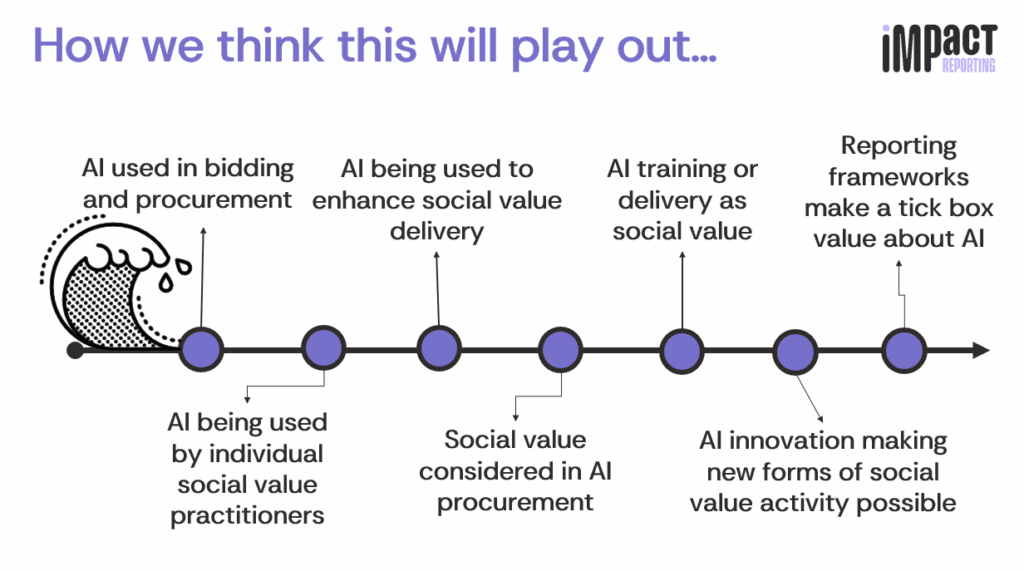
Understanding where we are in this timeline helps practitioners prepare for what’s coming next.
Practical AI Applications for Social Value Practitioners
Research and Local Needs Analysis
AI tools like Perplexity and Notebook LM are transforming how we conduct research and understand local needs. Rather than replacing human insight, these tools help practitioners process vast amounts of information more efficiently – from ONS data to social media sentiment and local news coverage. (That’s what is powering our new local needs analysis within our software)
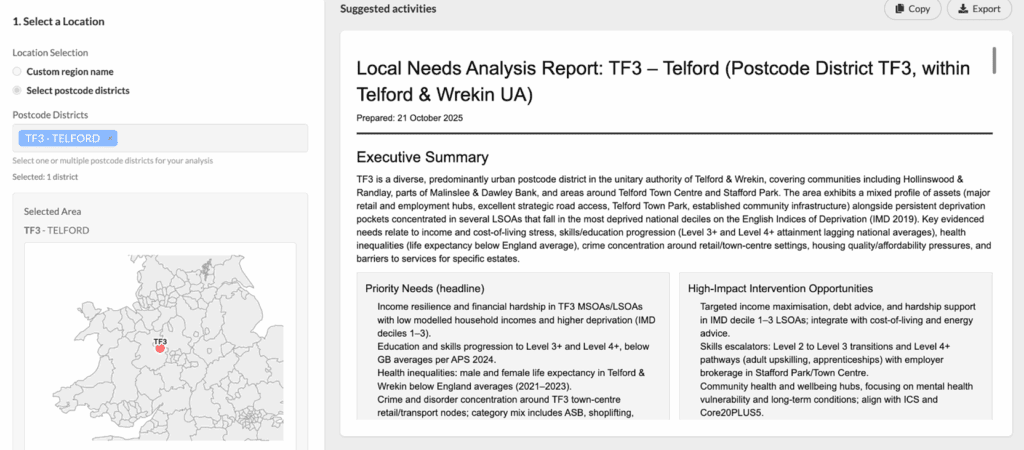
The key is understanding AI’s strengths: it’s brilliant at processing large volumes of text and identifying patterns, but it still requires human judgment to interpret findings and engage directly with stakeholders.
Stakeholder Consultation and Engagement
One of the most powerful applications we demonstrated was using AI to enhance stakeholder consultation. From real-time visualisation of community feedback to multilingual content creation, AI can help us have deeper, more meaningful conversations with the communities we serve.
Consider the possibility of instantly visualising what a proposed community space might look like based on stakeholder input, or translating consultation materials into multiple languages while preserving tone and intent. These capabilities make consultation more accessible and inclusive.
Data Analysis and Measurement
Processing 90,000 words of interview transcripts used to take weeks. With AI, this can be done in hours, allowing practitioners to identify themes, extract insights, and analyse sentiment at scale. Tools like V0 Labs can transform unstructured feedback into structured data that reveals patterns and impacts.
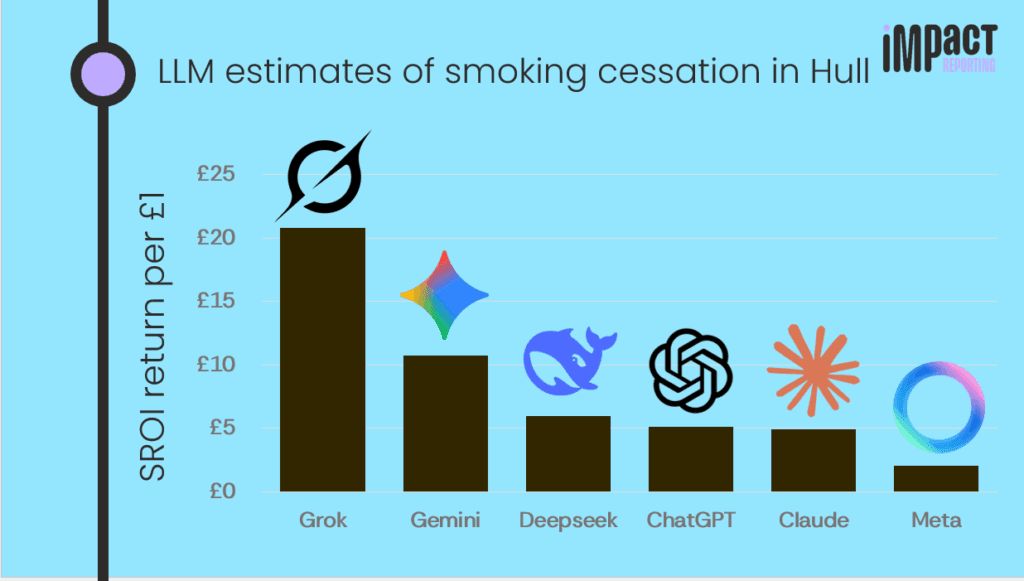
However – and this is crucial – AI cannot and should not replace the rigorous methodologies required for social value measurement and monetization. We found significant variance in AI-generated social value calculations, reinforcing why robust, evidence-based approaches remain essential.
The Ethical Imperative: Five Principles for Responsible AI Use
As social value practitioners, we must be especially thoughtful about AI ethics. We recommend a five-principle framework:
- Beneficence: Does using AI make the world or someone’s life better?
- Non-maleficence: Are we doing any harm through our use of AI?
- Justice: Does AI advance or diminish fairness and equity?
- Autonomy: Are we enhancing or limiting people’s agency?
- Explicability: Can we clearly explain how and why we used AI?
Critical Pitfalls to Avoid
Our webinar highlighted several risks that social value practitioners must navigate:
- Hallucinations and inaccuracies: AI can confidently present false information
- Bias: AI reflects the biases present in its training data
- Data privacy: Sensitive stakeholder information requires careful handling
- Environmental impact: AI training has significant carbon and water costs
- Over-reliance: Using AI as a substitute for genuine stakeholder engagement
The most important principle? Always keep a human in the loop. AI should augment human judgment, not replace it.
Advanced Techniques: Getting More from AI
For practitioners ready to level up their AI use, we shared advanced techniques:
Context Engineering
Rather than just typing prompts, load relevant context first. Create “context documents” with your organisation’s background, values, and language preferences. This dramatically improves output quality and relevance.
Prompt Engineering Frameworks
Use structured approaches like RTF (Role, Task, Format) to craft better prompts:
- Role: “You are a social value practitioner…”
- Task: “Write an agenda for a stakeholder consultation…”
- Format: “As a single A4 page in plain language…”
AI Marking Its Own Homework
Get one AI to fact-check another. Paste ChatGPT’s output into Claude and ask it to verify the information. This catches errors and improves accuracy.
The Bottom Line: Human Beings + Evidence + AI
The formula for successful AI integration in social value is clear:
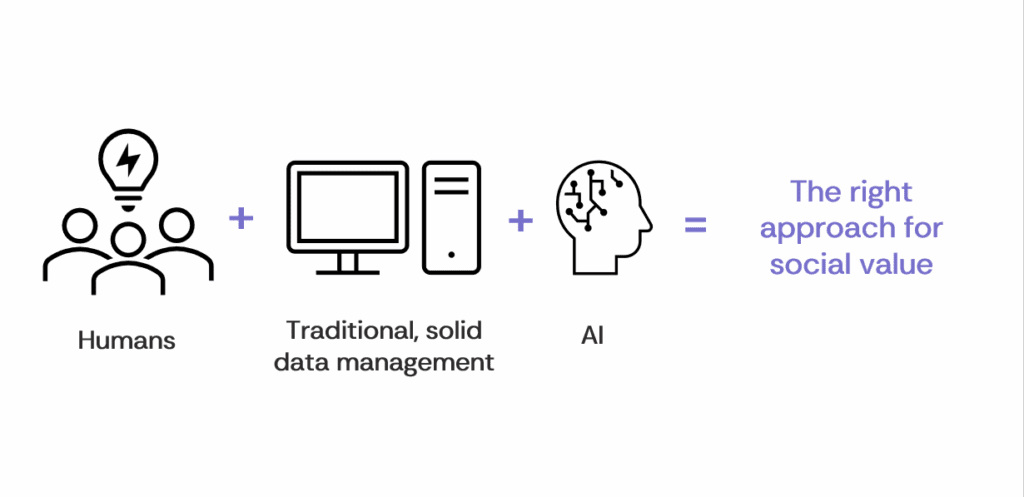
Human insight + Traditional, solid data management + AI = The right approach for social value
What doesn’t work:
Outsourcing everything to AI = Poor social value practice
AI is a powerful tool for enhancing human capacity, freeing us to do more of what we do best – building relationships, understanding context, and creating meaningful impact. But it cannot replace the human judgment, empathy, and stakeholder engagement that lie at the heart of good social value work.
Looking Ahead: New Social Value Opportunities
Perhaps the most exciting question for practitioners is: What new social value needs and opportunities does AI create?
As our stakeholders increasingly live in an AI-driven world, we need to consider:
- Digital literacy and AI skills training as social value activities
- Supporting communities affected by AI-driven automation
- Ensuring ethical AI deployment in our supply chains
- Helping vulnerable populations navigate AI-powered services and avoid scams
Watch the Full Webinar
Want to dive deeper into these insights? Watch the complete webinar recording to see live demonstrations of AI tools in action, learn specific prompts that work, and understand the full context of AI’s role in social value.

About the author