

You Can’t Spreadsheet Your Way to Social Value: What We Learned from DXC Technology
We recently hosted a webinar with Shelley Cotterill, Head of Social Value at DXC Technology, one of Impact’s clients and the world’s leading enterprise tech and innovation partners delivering software, services, and solutions to global enterprises and public sector organisations. The title was a bit of a provocation: You Can’t Spreadsheet Your Way to Social Value. And honestly? The conversation that followed more than lived up to it.
Here’s a summary of the key themes and practical examples shared in the session. Whether you work in social value, procurement, sustainability, or you’re just trying to figure out what your tech company should actually be doing in this space, there’s something useful for you.
First, a Quick Framing: Tech Is a Tool, Not a Goal
We talk about technology constantly: AI, digitisation, automation, infrastructure modernisation. It’s everywhere. And rightly so. But one of the things Catherine Manning, our Director of Impact Practice, said right at the start of the webinar has stuck with me:
“Tech isn’t the end goal. It’s a tool to support us to achieve our goals – societal goals, community goals, wellbeing goals.”
That’s the lens we’re working with here. And it’s a useful corrective, I think, because it’s easy to get lost in the tech and forget what it’s actually for. Which brings us to social value – and what it genuinely means to embed it inside a major technology company.
Who Is DXC Technology, and Why Do They Care?
DXC Technology is a global enterprise technology company – they deliver software, services, and solutions to large enterprises and public sector organisations. They’re a strategic government supplier, working on everything from managed infrastructure to AI-driven transformation. In short, they operate at serious scale, and they have real skin in the game when it comes to how government procurement works.
Shelley Cotterill joined DXC after fourteen years in community pharmacy – frontline work, deeply embedded in local communities, supporting individuals and families through COVID and beyond. Her route into a Head of Social Value role at a global tech company is not the conventional one. And I think that’s exactly what makes her perspective so grounded.
“It sounds weird to say, but I fell into social value. It has always been a passion of mine personally.”
Her point (one that came up repeatedly) is that social value isn’t a bolt-on. At DXC, it’s embedded in how the business thinks about procurement decisions, supplier relationships, employee wellbeing and community investment. It’s not a tick-box exercise. It’s a strategic function with a dedicated team and a clear mandate. And that makes a massive difference in how social value is treated and appreciated in the business.
The Policy Context: PPN 002 and the New Social Value Model
For those less familiar with the policy landscape: the UK government updated its Social Value Model in October 2024, introducing PPN 002. (For a more in-depth analysis, check out our blog post here) This replaced the previous model and updated the themes to align with the current government’s five strategic missions:
Kickstart economic growth. Make Britain a clean energy superpower. Take back our streets. Break down barriers to opportunity. Build an NHS fit for the future.
For suppliers bidding on government contracts over £5 million, social value now carries a minimum weighting of 10% in procurement decisions. In practice, this means you need to be able to demonstrate impact across themes like fair work, green innovation, health and wellbeing, equal opportunities, and community investment – not just claim it.
As Shelley put it, the skills development piece has become particularly urgent. Curriculum keeps up with technology imperfectly at best, and the digital skills gap is real and growing. That’s not background noise for DXC – it’s directly relevant to the sector they operate in and the communities they work within.
What Does DXC Actually Do? Three Programmes Worth Knowing About
This was the part of the webinar I found most compelling – moving from the policy framework into the concrete, messy, real-world practice. Here are three programmes Shelley walked us through.
The Dandelion Programme
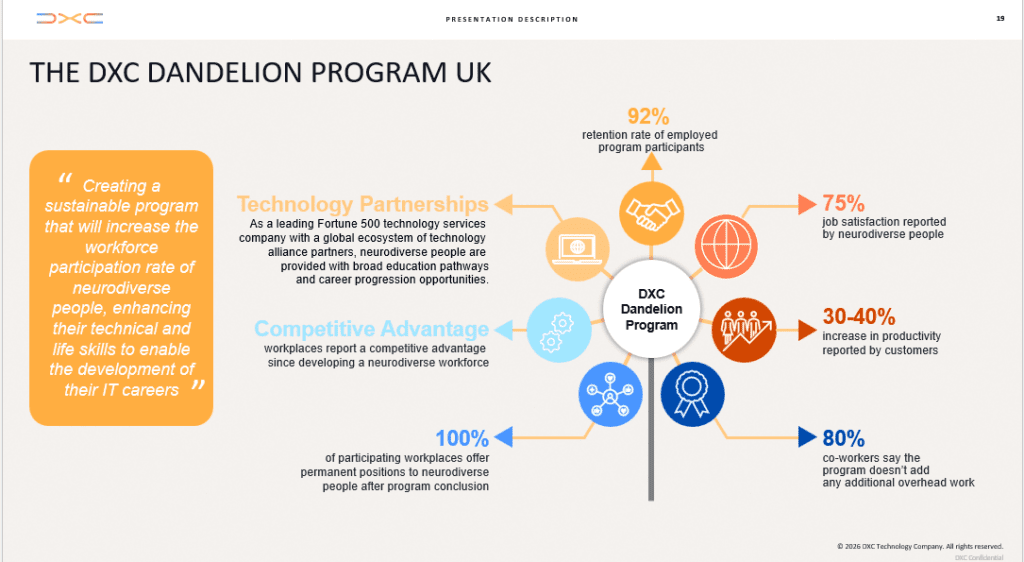
The Dandelion Programme is designed to support and celebrate the talents of neurodiverse individuals – people with autism, ADHD, dyslexia, and related conditions – and help them build careers in technology.
“The different ways of thinking and diverse perspectives can actually bring an increase in productivity. They think differently. It’s out-of-the-box thinking that allows them to see patterns the way that we don’t necessarily see patterns.” And the results are striking: a 92% retention rate among Dandelion participants, with 75% reporting high job satisfaction.
80% of participating workplaces report a competitive advantage since developing a neurodiverse workforce – and 100% of participating workplaces have gone on to offer permanent positions to neurodiverse people after the programme concludes.
Perhaps most telling: 80% of co-workers say the programme adds no additional overhead to their work. The programme has also had a measurable effect on productivity: DXC reports a 30–40% increase in productivity from teams that include neurodiverse individuals.
DXC also built a Dandelion Buddy system, training colleagues to better understand and support their neurodiverse peers. It’s the kind of detail that separates a genuine programme from a PR one.
The Digital Futures Academy
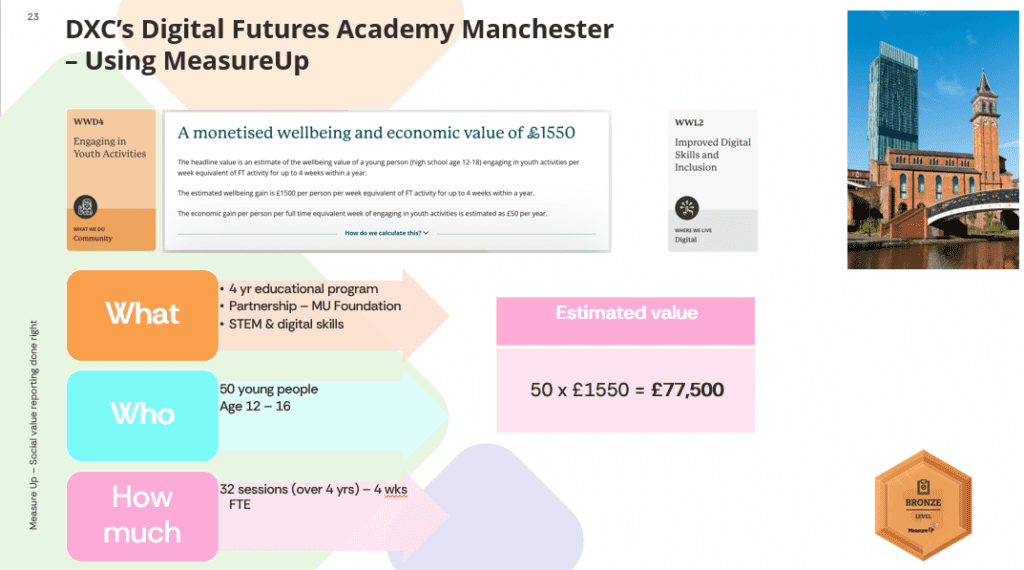
The Digital Futures Academy is a four-year STEM and digital skills programme aimed at secondary school students, co-created with the Manchester United Foundation and local teacher advisory groups. It began in Manchester (deliberately targeting deprived areas) and is now running in Glasgow and Newcastle too.
In Manchester, 50 students from six schools have been through the programme. In Glasgow, 52 students from eight schools. In Newcastle, 50 students from five schools, and for the first time, a 50/50 gender split, which Shelley highlighted as genuinely exciting progress in a sector where gender imbalance remains a serious issue (hoorah!).
The curriculum blends STEM skills with mentoring and personal development. Specifically, it covers Emerging Technology, Cyber Security and Virtual Reality, Automation and Big Data, and Professional Development skills, a mix that reflects what DXC actually knows and delivers, rather than a generic school outreach offering. The explicit ambition is to develop the social leaders of the future – not just future tech workers, but people who understand how to navigate and shape their communities.
One of the audience questions during the webinar was worth noting here: were these programmes set up in response to specific contracts, or are they company-wide initiatives? Shelley’s answer was honest – it’s both. Manchester grew from an existing sponsorship relationship with Manchester United. Newcastle and Glasgow were shaped by the fact that DXC has offices in those cities. A London cohort is now in the pipeline, and that one is contract-associated. Neither origin story makes the programme less real. It just reminds us that social value doesn’t always emerge from purely altruistic impulse (and that’s fine!).
The STEM Ambassador Programme
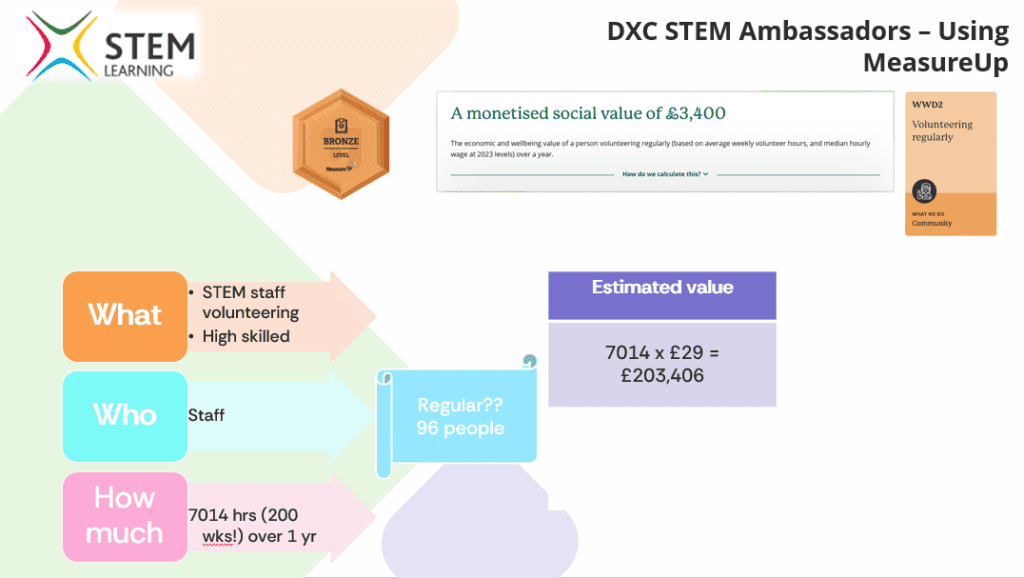
In FY25, DXC’s STEM ambassadors delivered 216 activities, contributing 7,014 volunteer hours and reaching over 30,000 participants. Shelley was characteristically direct about her enthusiasm for it: “I applaud every single one of you. If you’re not a STEM ambassador, I recommend you become one.”
It’s a significant number – and a reminder that the people doing the voluntary work experience real wellbeing benefits too, not just the communities they’re serving.
Trying to Measure It: A Live Experiment
One of the things I genuinely enjoyed about this webinar was the decision to actually attempt to value some of DXC’s programmes using the MeasureUp framework – live, in the session with Catherine’s guidance, as an experiment rather than a polished presentation.
MeasureUp is our open social and environmental measurement and valuation resource. It provides proxy values – approximate monetary estimates of wellbeing and economic outcomes – that organisations can use to calculate social value even when they don’t have gold-standard qualitative data. The approach runs from Bronze (working with what you’ve got) through Silver and Gold (adding richer demographic data or direct participant feedback) to Gold plus.
For the Digital Futures Academy, Catherine used the MeasureUp value for “Engaging in Youth Activities” which is a wellbeing and economic value of approximately £1,550 per young person. Across 50 participants, that gives an estimated gross social value of around £77,500 for one Manchester cohort. We then applied a 50% attribution discount to reflect the programme’s co-delivery with the Manchester United Foundation, landing at roughly £38,750 attributable to DXC. As Catherine was careful to say:
“This is Bronze-level estimation. It’s not an audited report. But it’s a start, and sometimes a start is exactly what’s needed to make the numbers feel real.”
For the STEM Ambassador programme, the calculation had a bit more layering. Using a wage-replacement cost of £29 per hour for skilled volunteer work, 7,014 hours translates to approximately £203,400 of economic value. Applying a 25% discount (a relatively conservative figure, acknowledging that some of this volunteering might have happened regardless), you land at around £152,500 attributable to DXC. Add in the wellbeing calculation for the approximately 96 people “Volunteering regularly” – using NCVO’s benchmark of 8 hours a month and a wellbeing value of £1,600 per regular volunteer per year – and that’s another estimated £115,000 in wellbeing value after discount.
None of these numbers are definitive. But they do something important: they give teams a way into the conversation about value that goes beyond counting outputs. And they make the “so what?” question answerable.
The Key Lesson: You Still Need the Story
This was the line that landed hardest, and it’s what the webinar’s title points to. Shelley was direct about it:
“Yes, fine, you can add your metrics and store them in a spreadsheet. But it doesn’t give you the story. It doesn’t actually get people invested.”
The data matters. The KPIs matter. Knowing how many apprentices you’ve hired, how many carbon emissions you’ve reduced, how many volunteer hours your teams have given – all of that matters. But data without narrative is just data. It doesn’t bring colleagues, clients, or communities on the journey with you.
There’s a practical dimension here too. Different audiences need different versions of the information. The person who cares about procurement compliance isn’t reading the same thing as the employee who wants to know what their volunteer hours actually achieved. Getting the story right means thinking about who you’re telling it to – and why it should matter to them.
Looking Ahead: What’s Coming in 2026 and Beyond
Shelley closed with her read on the trends shaping the tech and social value landscape over the coming year. A couple of things stood out.
- The digital skills gap is widening. Technology is moving faster than education systems can track, and that’s creating real risk – particularly around national infrastructure, where specialist knowledge is retiring out and not being replaced quickly enough. The emphasis on cloud has come at the expense of other skills, and the industry is only just starting to reckon with that.
- The gender gap in AI is a serious and underacknowledged problem. Only 22% of AI-related roles in the UK are occupied by women. That’s not just an equity issue – it’s a structural one. If you’re building AI systems with a severely skewed workforce, you’re encoding bias in ways that are hard to identify and harder to undo. Shelley was clear that encouraging girls into tech and ensuring equal access to STEM pathways isn’t optional. It’s essential, and it’s where she sees meaningful energy building in 2026. (Worth reading our blog on AI and listening Matt Haworth’s webinar here)
Both of these feel like areas where organisations can move beyond compliance and towards genuine strategic commitment – which, as DXC’s practice shows, is where the most interesting and durable social value tends to happen.
Why This Conversation Mattered
Part of what I valued about this webinar was its honesty. Shelley didn’t present a polished, everything-is-wonderful version of DXC’s social value practice. She talked about the challenges of running place-based programmes as a global company, the slow cultural shift from CSR to genuine social value, and the ongoing work of making sure that measurement actually supports story-telling rather than replacing it.
And Catherine’s decision to work through the MeasureUp framework in real time reflected something we believe pretty firmly: that imperfect, honest attempts to measure impact are more useful than polished reports that nobody trusts.
If You’re Finding Social Value Hard Right Now…You’re Not Alone
Social value can feel like a lot. The policy landscape keeps shifting, the pressure to demonstrate impact is real, and it’s genuinely not always clear where to start – or how to move from data collection to something that actually means something to the people you’re reporting to.
If any of that resonates – whether you’re a tech company trying to figure out what social value looks like for your organisation, a team carrying the social value function as a side-of-desk responsibility, or an organisation that has the data but isn’t sure what to do with it – we’d genuinely love to help you.
Impact Reporting exists to help organisations make more sense of their social value practice – and to make that practice better. Whether that’s through our platform, through MeasureUp, or through our consultancy work, we’re here for practical conversations, not sales pitches.
Get in touch if you’d like to learn more.
Watch Webinar recording:
To learn more about MeasureUp, visit: www.measure-up.org.
— Nil Khalifa

About the author